By JIM BRUGGER and FRED YERZY
Open Sky Outreach
(Editor’s Note: This is the first in a new series, to be provided monthly by contributors Jim Brugger and Fred Yerzy, offering a look at the local skies and what residents can see when they look upward in the evenings and just prior to sunrise.)
Planet Parade:
Venus is the brightest object in the night sky this month. Looking west, just after sunset, make a fist and hold it at arm’s length. Venus will be about two fist-widths (20 degrees) above the horizon.
Jupiter starts the month southeast (above and to the left) of Venus and is the second brightest object in the night sky. Take time to observe the motion of these “wandering stars” throughout the month as Jupiter moves closer to the horizon and passes within one degree (about the width of your pinky) of Venus on June 9.
Mercury can be found if you look closely, just above the horizon, about two fists north (to the right) of Venus. Binoculars may help you pick it out of the evening twilight. On the 16, look for the sliver of a waxing crescent moon about halfway between Mercury and Jupiter.
Saturn and Mars join the parade in the morning sky this month. Look to the east, just before sunrise, and Saturn will be about three fists above the horizon with Mars, the brighter of the two, just above the horizon.
Constellations and Celestial Highlights:
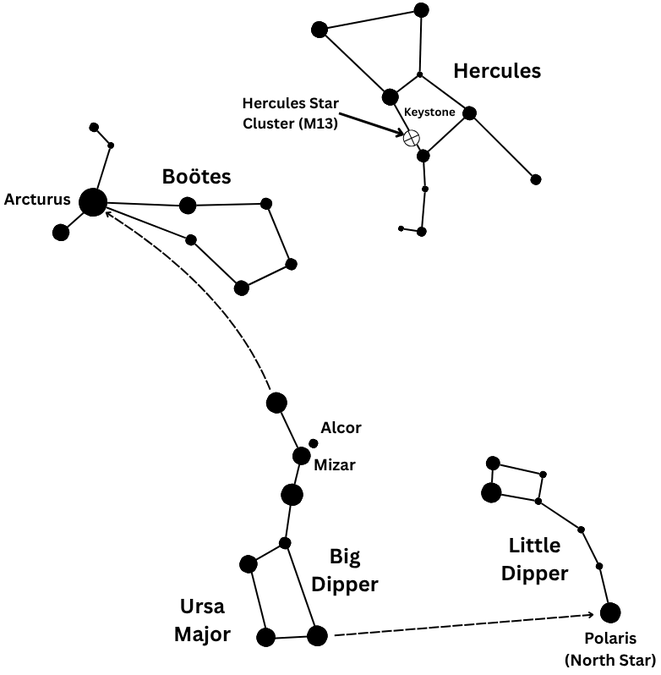
Facing north, you will find the Big Dipper has rotated to the west and looks like it is hanging on a hook in a cosmic kitchen. The two stars on the outer edge of the bowl are nearly horizontal and point to Polaris, the North Star. Follow the arc of the three stars in the Big Dipper’s handle and “arc” over to the red giant star Arcturus in the constellation Boötes.
Test your vision with the Mizar/Alcor star system. Look closely at the middle star of the Big Dipper’s handle. Can you see two stars? If so, congratulations, you have 20/20 vision!
By mid-month, the “Summer Triangle” asterism makes its appearance low in the northeast after 9:30 p.m. Look for three bright stars: blue-white Vega (in the constellation Lyra), blue super-giant Deneb (in the constellation Cygnus) and blue-white Altair (in the constellation Aquila). Do you see the triangle? Using binoculars, compare the brightness and color of these with the red giant, Arcturus.
For a challenge, get away from city lights and, using binoculars, try to find the Hercules star cluster (M13). Look along the western edge of the trapezoid-shaped “keystone” that makes up the core of Hercules, about two fist widths from Vega, toward Arcturus. What looks like a fuzz ball is actually a globular cluster consisting of hundreds of thousands of stars!
Did you know?
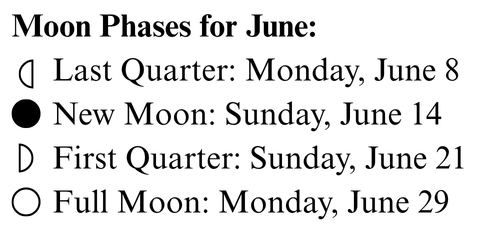
June’s full moon is called the Strawberry Moon. The name originates from Native American traditions to mark the season when wild strawberries and other fruit ripen.
Summer solstice, the longest day of the year in the northern hemisphere, occurs on Father’s Day, June 21.
Tech Talk:
Asterism: A pattern of stars that forms a recognizable shape. They can be part of a single constellation or made up of stars from multiple constellations. Examples include the Big Dipper and the Summer Triangle. Can you make your own asterisms?
Local Outreach Events:
Friday, June 5, 7 p.m. to 10 p.m.: Great Valley Museum Science Night, MJC West Campus, featuring a natural history museum, hands-on exhibits, planetarium shows and rooftop observatory (https://www.mjc.edu/gvm/index.html).
For Open Sky Outreach, Star Tours and Telescope Talks, email openskyoutreach@gmail.com.