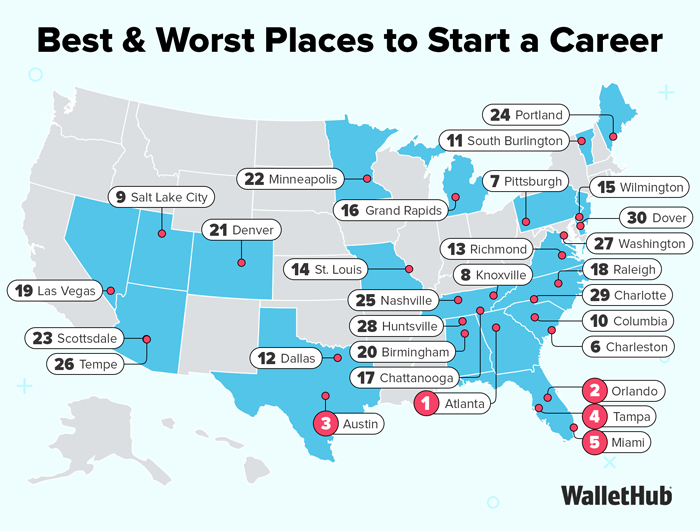
With graduation season upon us and many employers in the U.S. reporting difficulty finding qualified talent, the personal-finance company WalletHub on May 11 released its report on 2026’s Best & Worst Places to Start a Career, as well as expert commentary, to help recent graduates launch their careers in the right place. Three of the top 10 locations were in Florida; three of the worst locations were in California.
WalletHub compared more than 180 U.S. cities based on 25 key indicators of career-friendliness. The data set ranges from the availability of entry-level jobs to monthly average starting salary to housing affordability.
Best Places to Start a Career
Atlanta, Georgia was rated as the best place to start a career among those in the study, followed by Orlando, FL. The rest of the top ten were: Austin, TX; Tampa, FL; Miami, FL; Charleston, SC; Pittsburgh, PA; Knoxville, TN; Salt Lake City, UT; and Columbia, South Carolina.
Worst Places to Start a Career
Rated at the bottom of the study were Anaheim, California at number 173, followed by Jackson, MS; Shreveport, LA; Pearl City, HI; Oxnard, CA; Chula Vista, CA; Port St. Lucie, FL; Detroit, MI; Bridgeport, CT; and, at number 182, New York, NY.
Best vs. Worst
Austin, Texas, has the highest monthly average starting salary (adjusted for cost of living), which is three times higher than in Juneau, Alaska, the city with the lowest.
Columbia, Maryland, has the highest median annual household income (adjusted for cost of living), which is 3.3 times higher than in Detroit, the city with the lowest.
Oxnard, California, has the highest workforce diversity, which is 2.3 times higher than in New Haven, Connecticut, the city with the lowest.
Sioux Falls and Rapid City, South Dakota, have the lowest unemployment rate, which is 5.2 times lower than in Detroit, the city with the highest.
“Transitioning out of school and into the workforce can be a difficult and stressful process, but certain cities make things a lot easier than others. The best cities for starting a career not only have a lot of job opportunities but also provide substantial income growth potential and satisfying work conditions. It’s also important to consider factors such as how fun a city is to live in or how good of a place it is for raising a family, to ensure life satisfaction outside of your career,” said WalletHub Analyst Chip Lupo. “Atlanta is the best place to start a career, with strong job growth of 2.08% annually, ranking 10th in the nation. Plus, the median annual household income in Atlanta is already pretty high, at over $90,400. In addition, Atlanta has a lot of job opportunities at companies that are rated at least 4 out of 5 stars on Glassdoor, along with plentiful entry-level jobs, and residents have a high rate of satisfaction with their jobs.”
To view the full report, visit:
https://wallethub.com/edu/best-worst-cities-to-start-a-career/3626
Expert Commentary
What can city policymakers and corporations do to attract and retain recent graduates?
“For a city to attract young professionals, they need to focus on affordability and opportunity. Young professionals need housing, reliable transportation, and access to jobs with clear paths for advancement. It’s not just the cities who need to provide however; corporations also need to offer clear growth tracks, mentorship, a solid benefit plan and ideally financial wellness training and support (retirement plans, student loan assistance). Young professionals will look at more than just the job offer; they want to see if they can build a life there.”
Casey Halliley – Adjunct Professor, CUNY Baruch College
What is the biggest career mistake that young people make?
“Not taking advantage of the career services available at the college or university they are attending. Most schools offer help with resumés, interviewing and connecting with alumni from the institution and comparatively few students take advantage of them.”
Scott Thorne, Ph.D. – Instructor, Southeast Missouri State University
“A lot of people always assume the grass is always greener so they often shop almost exclusively on price (e.g. salary), only to find that the culture or the working conditions are far worse than their previous employer, even though they might not be making as much money.”
Gregory L. Stoller – Master Lecturer, Boston University
Is starting a career in 2026 likely to be more challenging than in previous years? Why?
“Every generation faces challenges. For me it was 9/11, the tech bubble bursting, Y2K, Enron and Worldcom going bankrupt and many other terrible global problems. Now we have expensive housing, the potential threat of AI taking entry-level jobs, student loans and the overall increasing cost of living. But we also have access to remote work, online learning, an incredibly robust internet, investing platforms and … AI. Every generation has their own set of issues and advantages. Those who understand that early have a meaningful leg up.”
Casey Halliley – Adjunct Professor, CUNY Baruch College