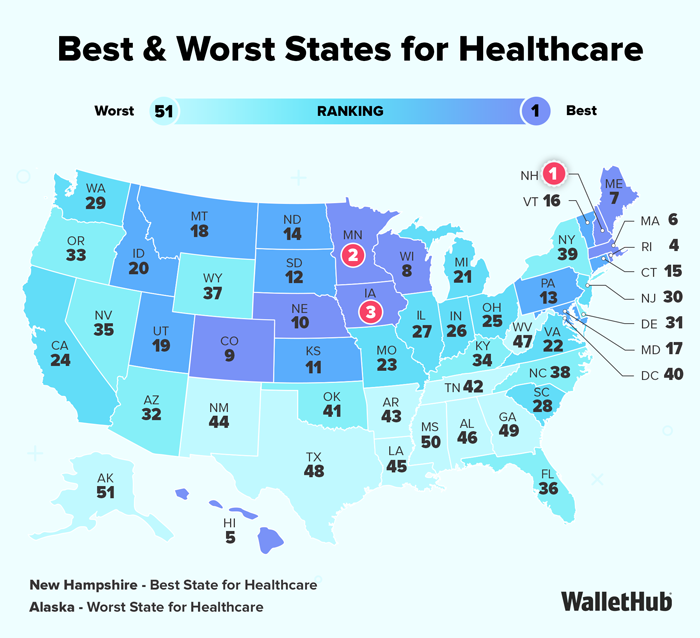
With the average American spending nearly $15,500 per year on healthcare, the personal-finance company WalletHub has released its report on the States With the Best & Worst Healthcare in 2026, as well as expert commentary, to identify where Americans receive the highest-quality services at the best prices.
WalletHub compared the 50 states and the District of Columbia across 44 key measures of healthcare cost, accessibility and outcomes. The data set ranges from the average monthly insurance premium to physicians per capita to the share of the population with health insurance.
Healthcare in California (1=Best; 25=Avg.):
Overall Rank: 24th
37th – Avg. Monthly Insurance Premium
44th – Hospital Beds per Capita
23rd – Physicians per Capita
10th – Dentists per Capita
22nd – % of Insured Adults
11th – % of Insured Children
44th – % of At-Risk Adults with No Routine Doctor Visit in Past Two Years
22nd – % of Adults with No Dental Visit in Past Year
1st – % of Medical Residents Retained
“Healthcare has two crucial components, cost and quality. The best healthcare in the nation isn’t helpful if it bankrupts the people who try to get it, and cheap healthcare isn’t worth paying for if it provides subpar or ineffective treatment. Therefore, the best states for healthcare are those that make high-quality care affordable, on top of providing many options for doctors and making insurance easily accessible,” explained WalletHub Analyst Chip Lupo. “New Hampshire is the best state for healthcare, with the second-lowest out-of-pocket medical spending in the country. Residents also have the lowest average monthly health insurance premium, at around $469. To top things off, New Hampshire has the fourth-lowest share of residents with heart attacks, lowest prevalence of strokes and the fourth-lowest prevalence of type-2 diabetes in the country.”
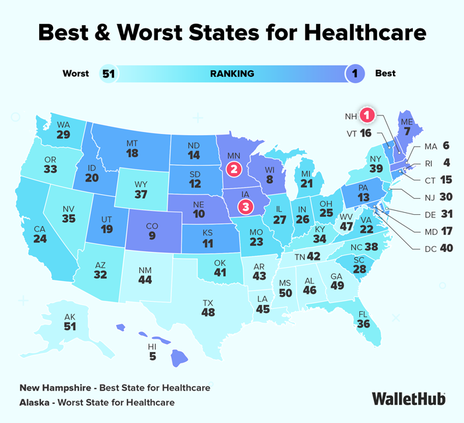
Alaska was at the bottom of the list, rated as the worst state for health care.
For the full report, visit: https://wallethub.com/edu/states-with-best-healthcare/23457
Expert Commentary
What tips do you have for a person looking to find the right balance between the cost of premium and level of coverage?
“Patients can maximize insurance utilization, use tax-advantaged accounts, select low-cost care, and opt for generic medications if appropriate. To maximize insurance usage, patients can select providers who are in-network, secure prior authorizations for specialized procedures before tests and treatments if required by insurance, take advantage of free preventive services, and review itemized bills against explanations of benefits.”
Rui Yao, Ph.D., CFP – Professor, University of Missouri
“It is very challenging to assess one’s own or family’s health risks and make choices of health insurance products accordingly. It is like gambling with your health and money. What is the ‘right balance’ between the cost of premiums and level of coverage can vary significantly across individuals and families. The only tip I can give for the individual health insurance market is to be aware of high deductible (sometimes referred to as ‘major medical’ or ‘catastrophic’ insurance). Before you decide on such a product, you have to check your financial status by asking ‘Do I have the sufficient funds to pay for the annual deductible?’ If you don’t, this kind of product is not for you because such a plan will be nearly useless to you.”
Chunhuei Chi, Sc.D., MPH – Professor, Oregon State University
What are the most important steps Americans can take to minimize health-related expenditures?
“Health Savings Accounts (HSAs) associated with high-deductible health plans and Flexible Spending Accounts (FSAs) allow patients to pay for medical expenses using pre-tax dollars. Instead of going to the emergency room for non-life-threatening issues, choose urgent care or telehealth services for routine follow-ups or initial assessments. Ask providers to write prescriptions for bioequivalent generic drugs if applicable.”
Rui Yao, Ph.D., CFP – Professor, University of Missouri
“The most important step is to keep oneself healthy. At the same time, there are also factors affecting an individual’s health that are beyond an individual’s control (the societal determinants of health). Which is why collective healthcare financing, whether through private insurance, or through public health insurance, is vital to minimizing health-related expenditures.”
Chunhuei Chi, Sc.D., MPH – Professor, Oregon State University