With financial stress costing the U.S. employers $250 billion per year, the personal-finance company WalletHub has released its report on 2026’s Most & Least Stressed Cities in America, as well as expert commentary, to show where people are struggling and may need assistance.
WalletHub compared more than 180 cities across 39 key metrics. The data set ranges from average weekly work hours to the unemployment rate to divorce and suicide rates.
Three cities in California were among those determined to be the ‘least stressed’ in the study.
Most Stressed Cities
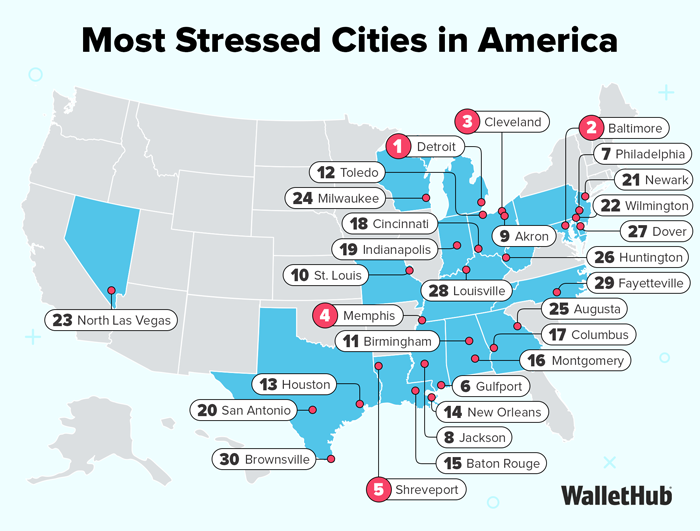
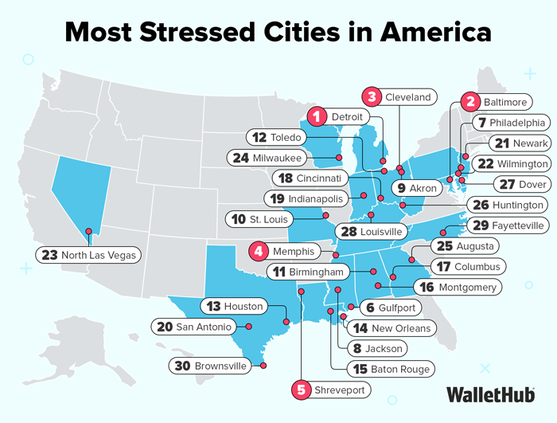
Detroit, Michigan was the most stressed city, coming in at number one, followed by Baltimore, MD; Cleveland, OH; Memphis, TN; Shreveport, LA; Gulfport, MS; Philadelphia, PA; Jackson, MS; Akron, OH; and rounding out the top 10, St. Louis, Missouri.
Least Stressed Cities
On the opposite end of the scale, Burlington, Vermont was among the least stressed cities, coming in at number 173. It was followed by Sioux Falls, SD; San Jose, CA; Irvine, CA; Overland Park, KS; Lincoln, NE; Fargo, ND; Bismarck, ND; South Burlington, VT; and, at number 182, ranked as the least stressed city in the WalletHub study, Fremont, California.
Best vs. Worst
Rapid City, South Dakota and Honolulu, Hawaii, have the lowest unemployment rate, which is five times lower than in Detroit, Michigan the city with the highest.
Fremont, California, has the lowest divorce rate, which is 4.4 times lower than in Cleveland, Ohio, the city with the highest.
Cheyenne, Wyoming, has the lowest share of adults in fair or poor health, which is 3.1 times lower than in San Antonio, Texas, the city with the highest.
Columbia, Maryland, has the highest median annual household income (adjusted by cost of living), which is 3.3 times higher than in Detroit, the city with the lowest.
To view the full report, visit:
https://wallethub.com/edu/most-least-stressed-cities/22759
“Some stress is out of our control, due to issues with family, friends or employers. However, where you live can play a big role in how stressed you are. Cities with high crime rates, weak economies, less effective public health and congested transportation systems naturally lead to elevated stress levels for residents. When moving, it’s important to consider how a certain city may impact your mental health – not just your financial opportunities,” explained WalletHub Analyst Chip Lupo. “Detroit is the most stressed city, due in part to the fact that it has the lowest median household incomes in the country and the highest unemployment rate, at 10.4%. In addition, Detroit has the highest poverty rate in the country, residents are physically active at low rates, too, and the city has the fifth-highest obesity rate. On top of that, Detroit has one of the highest violent crime rates in the country.”
Expert Commentary
How can employers reduce work-related stress?
“Employers can use many techniques to reduce employee stress. According to OSHA, the WHO estimates that every dollar spent on reducing employee stress generates four times more productivity. Suggestions include identifying obstacles that hinder employees in their work and making helpful adjustments. Employers might also offer flexible schedules or locations and support like paid time off to bolster employee resilience. Employers should also recognize that employees may have outside burdens, such as caregiving, that add stress. The University of Massachusetts at Lowell suggests offering employee programs such as relaxation or exercise spaces, which are low-cost yet may greatly reduce stress.”
Jeanette Landin, Ed.D., MBA – Professor, Landmark College
“Employers can reduce work-related stress by recognizing that employee well-being is not solely an individual responsibility, but also a function of workplace culture and organizational practices. Clear expectations, manageable workloads, and realistic deadlines are foundational. Employees experience less stress when they have autonomy over how they accomplish their work, receive regular feedback, and feel supported by their supervisors. Organizations should also encourage employees to use vacation time, establish healthy boundaries around after-hours communication, and provide flexibility when possible. Research consistently shows that flexible work arrangements, supportive leadership, and psychological safety contribute to lower stress and higher engagement. Finally, employers should normalize conversations about mental health and ensure employees have access to meaningful wellness resources rather than relying solely on superficial wellness initiatives.”
Kristal A. Gerdes, Ph.D. – Professor, University of Wisconsin-Stout/Wisconsin’s Polytechnic University
What tips do you have for a person who finds managing finances to be stressful?
“Financial stress is one of the most widespread and persistent forms of stress in the United States and is often driven by uncertainty about income, rising costs of living, debt burdens, and lack of savings … creating a realistic budget is essential. This involves tracking monthly income and expenses to identify spending patterns and areas where adjustments can be made. Even small steps, such as reducing discretionary spending or automating bill payments, can reduce financial anxiety. Debt management is another critical area. Rather than attempting to address all debts at once, individuals may benefit from focusing on one obligation at a time, such as using the ‘snowball’ method, where they pay off the smallest balances first to build momentum and motivation, or the ‘avalanche’ method, where they prioritize debts with the highest interest rates first to minimize overall interest costs. Seeking assistance from nonprofit credit counseling services can also provide structure and guidance. Avoiding social comparison and focusing on personal financial progress can help individuals maintain a healthier mindset. Over time, small consistent improvements in financial behavior can significantly reduce stress and increase financial confidence.”
Cassandra D. Chaney, Ph.D. – Professor, Louisiana State University
“Financial stress often stems from uncertainty more than the actual numbers. The first step is to gain clarity by understanding your income, expenses, and financial obligations. A simple monthly budget can reduce anxiety by replacing uncertainty with a realistic plan. Rather than trying to solve every financial challenge at once, focus on one achievable goal, such as building a small emergency fund, paying down a specific debt, or automating savings. Breaking larger financial objectives into smaller milestones makes progress feel more attainable. It’s also important to recognize the connection between financial well-being and overall well-being. Financial stress can affect sleep, relationships, and job performance. Seeking guidance from a trusted financial counselor or using reputable financial education resources can help reduce stress while increasing confidence. Remember that financial wellness is a process, not a destination.”
Kristal A. Gerdes, Ph.D. – Professor, University of Wisconsin-Stout / Wisconsin's Polytechnic University
What are, in your opinion, the top financial stressors in 2026?
“Americans face many financial stressors in 2026. The rising cost of living, especially housing, is a primary concern, according to Gallup. Energy costs, including fuel and electricity, are another major stressor. Healthcare costs are also high, with premiums and medical expenses rising. Nearly half of Americans face moderate to severe hardship, per a Gallup poll in April 2026. Another issue is insufficient retirement savings, mentioned by over 60 percent of Americans. Inflation has worsened these stressors, and forecasts offer little relief.”
Jeanette Landin, Ed.D., MBA – Professor, Landmark College
“In 2026, financial stress continues to be driven by several interconnected factors. One of the most significant is the rising cost of living, particularly in housing, food, healthcare, and transportation. Inflation has increased household expenses, making it more difficult for families to maintain financial stability even with steady income … housing affordability remains a major concern, with rent and mortgage costs consuming a growing proportion of household budgets. In addition, consumer debt, including credit cards, student loans, and medical debt, continues to place significant strain on individuals and families. Many households report difficulty building savings or preparing for unexpected expenses. Another major stressor is uncertainty about long-term financial security. Concerns about retirement savings, job stability, and economic fluctuations contribute to ongoing anxiety. Even individuals who are currently employed may experience financial stress due to unpredictable expenses and limited financial buffers. These stressors often interact, creating a cycle of financial pressure that affects mental and physical health.”
Cassandra D. Chaney, Ph.D. – Professor, Louisiana State University