With October being National Energy Awareness Month and the average U.S. family spending at least $2,000 per year on utilities, the personal-finance company WalletHub has released its report on 2026’s Most and Least Energy-Efficient States, to see which states save people the most money while also saving the environment.
The Department of Energy estimates that adopting energy-efficient measures in the home could reduce a family’s utility costs by as much as 25%. It pays to conserve, especially during a time of increasingly warmer temperatures. As for transportation, the agency found that a more fuel-efficient vehicle could save the average driver over $1,000 per year.
WalletHub compared the energy efficiency of residents’ homes and automobiles in 48 U.S. states. Due to data limitations, Alaska and Hawaii were excluded from the analysis.
Energy Efficiency in California (1=Most Energy-Efficient; 24=Avg.)
Overall rank for California: 1st
3rd – Home Energy Efficiency
7th – Vehicle-Fuel Efficiency
6th – Transportation Efficiency
“Energy efficiency doesn’t just help save the planet – it also helps save you money by lowering the amount of electricity, gas, oil or other types of energy you need to consume. While there are some steps you can take to become more energy-efficient on your own, living in the right area can give you a big boost,” noted WalletHub Analyst Chip Lupo. “For example, certain states have much better public transportation systems that minimize your need to drive, at least in big cities. Some places also have better-constructed buildings that retain heat better during the winter or stay cooler during the summer.”
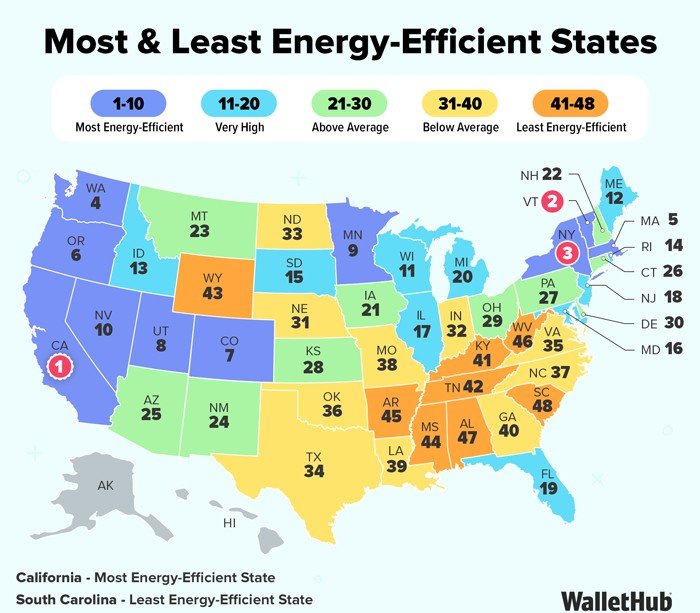
California was ranked first overall in the study, followed by Vermont, New York, Washington, and Massachusetts in the top five. On the other end of the scale were Mississippi at number 44, followed by Arkansas, West Virginia, Alabama and, rated as the least energy efficient state, South Carolina.
For the full report, visit: https://wallethub.com/edu/most-and-least-energy-efficient-states/7354
Expert Commentary
Dr. Miren Ivankovic
Professor of Economics,
Anderson University
What energy-efficient products for the home offer the best return on investment?
These days, one can find energy efficient appliances, bulbs, windows, energy production, etc. Under certain conditions, which are sun light days, family income, state and federal rebates, how long one will stay in the house, solar panels can have a very good return on the investment.
What is the biggest mistake consumers make when trying to make their homes more energy-efficient?
They do not consider how long they will stay in the house. Another one is that based on their income bracket, they can qualify for government subsidies. Another one is that some households focus on some energy efficient items, but those will bring small gains to the house. Insulating an attic, if the house has one, is important to keep the hot and cold air from coming in. That task might be more important than just replacing the windows in the house.
What are some tips for consumers to become more energy efficient, especially if they work from home?
Have your local energy company come in and inspect your home and give you an assessment on where you can improve your energy efficiency. Look into your water usage and your electricity usage and see if those can be improved by installing different shower heads or placing the solar panels on the roof.
Should the government continue to incentivize consumers and businesses to invest in energy-efficient projects?
If the government, especially the state and federal government, want to pursue the cleaner environment, those subsidies are important. After all, some energy efficient items are very expensive.
What tips can you provide for building an energy-efficient home on a budget?
I think this greatly depends on the location of the home. Some areas are much cheaper when it comes to water and electricity bills than the others. I think that the nature around the future home should also play a significant role in energy efficient housing. Finally, talk to the expert builders and compare the suggestions among a few. Energy-efficient technology has come a long way and is still improving.
Top Three
California is the most energy-efficient state, boasting the lowest residential energy consumption per capita and the third-highest home energy efficiency. In addition, California’s residents are efficient when it comes to automobiles. Californians drive fewer miles per year than people in all but five other states, an average of just 8,297 miles per year. This is due in part to the robust public transportation systems in its large cities. California also has the seventh-highest vehicle fuel efficiency.
Vermont is the second-most energy-efficient state, in large part because it’s the second-most vehicle-fuel efficient in the country. Vermonters drive an average of around 21 miles per gallon of gasoline, more than all U.S. states except one. On top of that, Vermont has the 10th-lowest residential energy consumption per capita, along with the second-highest home energy efficiency. This helps people in the state save money while saving the environment.
New York is the third-most energy-efficient state overall, ranking very well for both home and automobile efficiency. The state has the seventh-lowest residential energy consumption overall, and the 12th-best home energy efficiency. Residents consume relatively little energy in their homes compared to what you’d expect them to need based on the weather in the state, including its especially cold winters. When it comes to vehicles, New Yorkers drive an average of just 6,088 miles per year, the fewest in the country. They also have the 18th-best fuel efficiency based on the amount of gas consumed per mile driven.