By JIM BRUGGER and FRED YERZY
Open Sky Outreach
Planet Parade:
Venus gradually sinks into the evening twilight and will be the last planet visible in the early evening sky until September.
Mars continues its slow ascent in the eastern predawn sky all month.
Saturn rises earlier each night this month and is prominent after midnight facing east-southeast.
Uranus lies between Saturn and Mars and may be barely visible with the naked eye. Look about half-way between Aldebaran and the Pleiades star cluster. Binoculars or a small telescope may reveal Uranus’ blue color.
Neptune is challenging to find and requires a telescope to see. In August it lies about sixteen degrees west (right) and five degrees south (below) of Saturn.
Constellations and Celestial Highlights:
Partial Lunar Eclipse: When the full moon rises on the 27th, around 7:40 p.m., it will already be a partial eclipse. You can watch the shadow of the Earth progressively cover the lunar disk until it reaches the maximum eclipse at 9:12 p.m. The partial eclipse ends at 10:51 p.m. and the moon emerges from Earth’s shadow at 12:01 a.m.
The Perseid Meteor Shower peaks overnight, during the new moon, on August 12-13 with up to 50-100 meteors per hour. The best way to view the shower is to go out to a relatively dark location with a clear view to the northeast between 11 p.m. and 3 a.m. Get comfortable in a reclining lawn chair and let your eyes get dark-adapted for at least twenty minutes. Lay back and look for bright streaks and possible fireballs radiating from the constellation Perseus, which will be just below the “W” of Cassiopea. No binoculars or telescopes required.
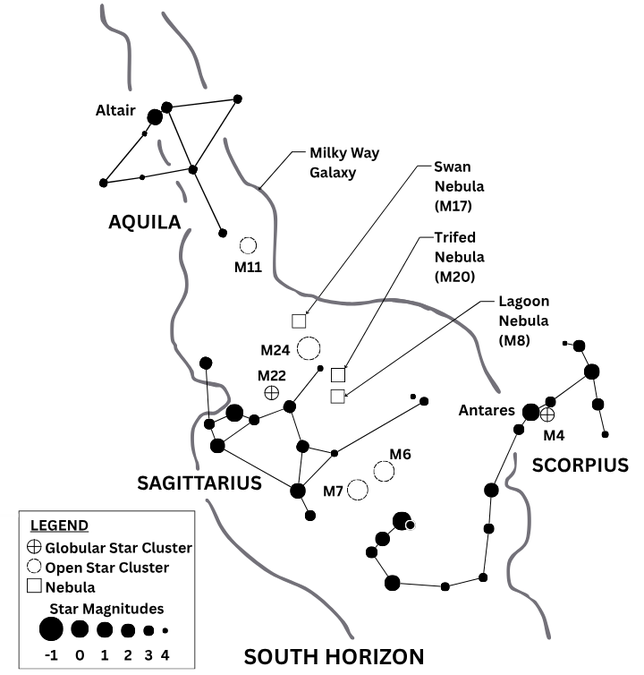
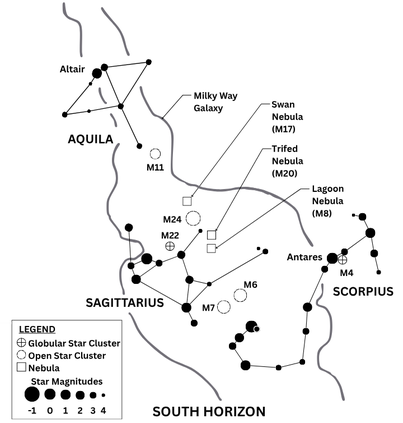
Sagittarius is prominent in the southern sky and is noted for its “teapot” asterism. When you see the spout of the teapot, you are looking at the exact center of our home galaxy and scanning the area with binoculars or a small telescope reveals a rich tapestry of nebulae and star clusters. The “steam” rising from the teapot’s spout gives the impression that it is pouring out the starry band of the Milky Way, which stretches across the sky from south to north.
Just west of Sagittarius is Scorpius (The Scorpion). In Polynesian and Hawaiian culture, the curving, j-shaped stinger of the scorpion was known as Maui’s Fishhook and the red supergiant star, Antares, marks the “heart” of the scorpion or the anchor point of the fishhook. The constellation, along with other prominent star patterns, provided a significant reference point for the successful navigation of vast distances of open ocean. In Hawaiian tradition, the fishhook (Mānaiakalani) was used by Maui to fish the Hawaiian Islands out of the ocean.
Did you know?
August’s full moon is called the Sturgeon Moon, named for the once-abundant, largest North American freshwater fish.
The Perseid meteors are dust particles, as tiny as grains of sand or small pebbles, from Comet Swift/Tuttle burning up in Earth’s atmosphere.
In light-polluted skies, the Milky Way is nearly impossible to see. Under dark, moonless skies, it can be breathtaking and bright enough to cast subtle shadows.
Tech Talk:
A meteor is a bright streak of light caused by a meteoroid heating up in Earth’s atmosphere. A meteorite is a chunk of meteoroid that survives the journey and strikes the ground.
Local Outreach Events:
Friday, August 7, 7-10 p.m.: Great Valley Museum Science Night, MJC West Campus, featuring a natural history museum, hands-on exhibits, planetarium shows and rooftop observatory (https://www.mjc.edu/gvm/index.html).
For Open Sky Outreach, Star Tours and Telescope Talks, email openskyoutreach@gmail.com.