PINE GROVE — Indian Grinding Rock State Historic Park is located in the Sierra foothills, eight miles east of Jackson.
The park is nestled in a small valley 2,400 feet above sea level with open meadows and large valley oaks that once provided Native Americans with an ample supply of acorns.
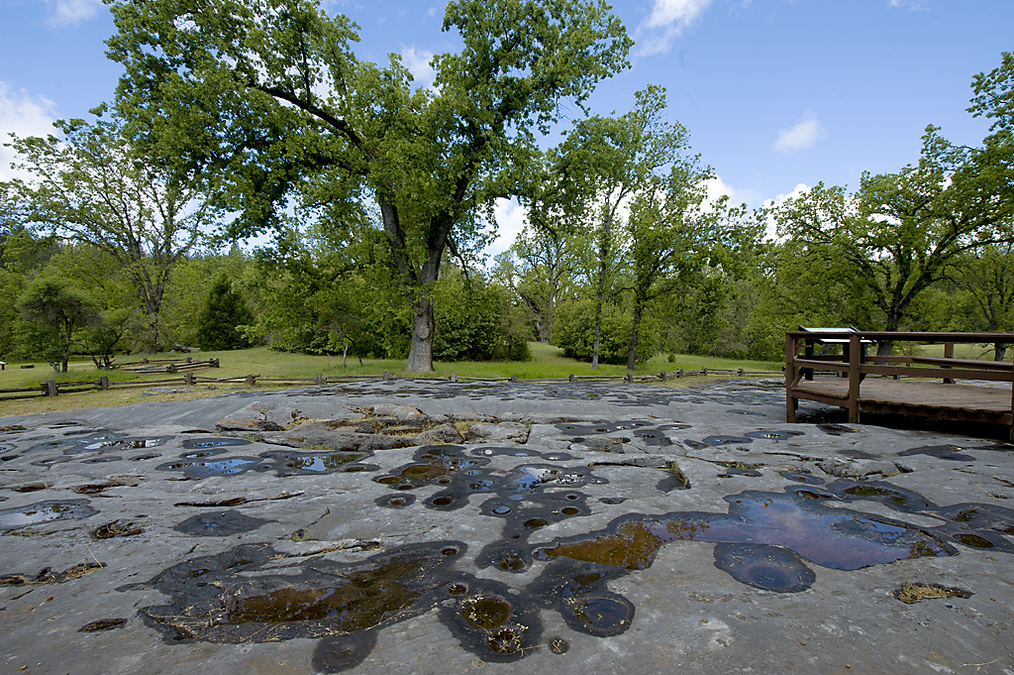
The 135-acre park preserves a great outcropping of marbleized limestone with 1,185 mortar holes — the largest collection of bedrock mortars anywhere in North America.
Trails make it easy to explore the meadows and surrounding forest.
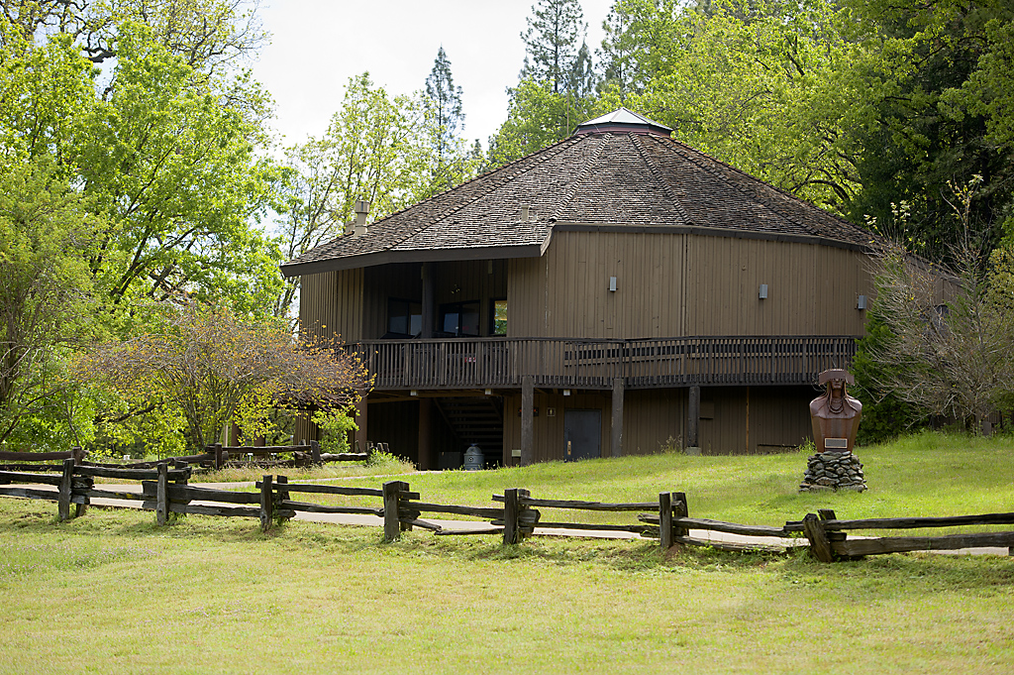
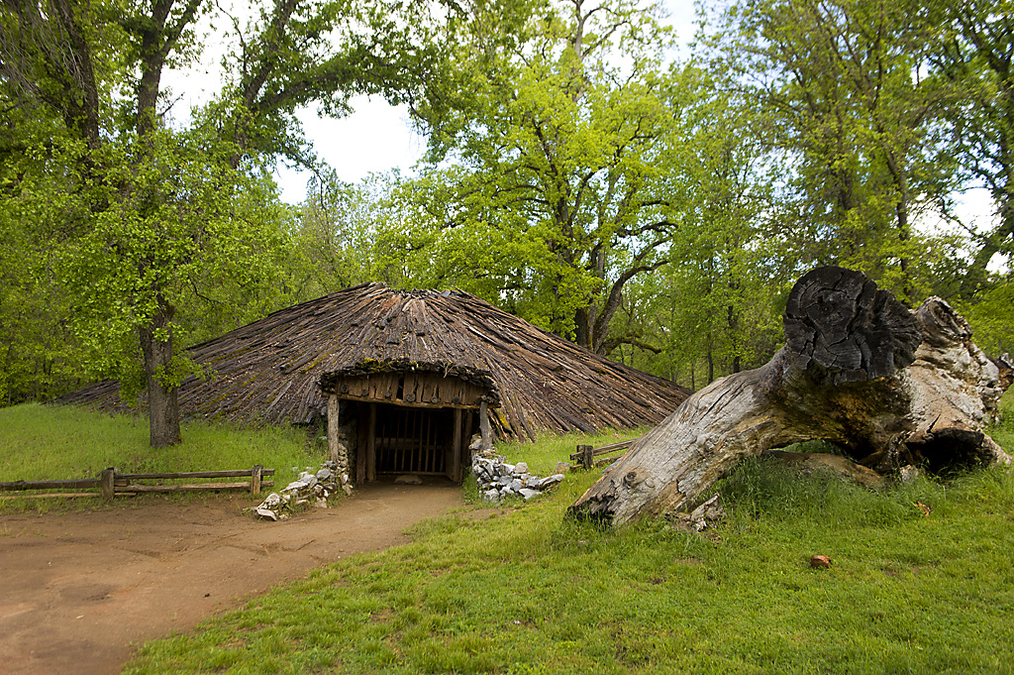
The Chaw’se Regional Indian Museum features a variety of exhibits and an outstanding collection of Sierra Indian artifacts. A Miwok village and roundhouse have been reconstructed in the middle of the valley.
Chaw’se is the Miwok word for the mortar cups that formed in a stone slab as the Miwok people pounded acorns and other seed into meal. The largest chaw’se example can be seen at the park.
The main grinding rock also features 363 petroglyphs — including circles, animal and human tracks, and wavy lines. Some of these carvings are thought to be as old as two or three thousand years; they are now becoming difficult to see.
This association of rock art and bedrock mortar pits is unique in North America. Except for one other small site, Indian Grinding Rock State Historic Park has the only known occurrence of mortars intentionally decorated with petroglyphs.
The marble grinding rock is fragile and very susceptible to weathering and chipping. The natural elements are claiming many of the petroglyphs, so stay off the rock and respect this irreplaceable reminder of indigenous Miwok culture.
History
The Northern Sierra Miwok, who settled in this area many centuries ago, established their villages alongside the rivers and streams of the Sierra Nevada — from the Cosumnes River on the north to the Mokelumne River on the south.
Other Miwok groups lived to the west as far as Mount Diablo and as far south as Yosemite National Park. The Miwok had a detailed understanding of the resources available to them, passing this knowledge down from generation to generation.
Deer were the most important animal resource, and all parts were utilized. The meat was used for food; clothing was made from the hide. Antlers, bones, and hooves were used for tools and instruments, and the brain was used to tan hide.
Plant foods were generally collected and processed by women while men trapped, fished, and hunted.
All resources were portioned so they would continue to be available, and little or nothing was wasted. For example, a plant called soap root was mashed and used not only as soap, but also to stun and catch fish. Its leaves were eaten fresh, and the bulb could be baked and eaten. The dried, fibrous leaves were bundled and used as a brush.
Acorns, the mainstay of the Miwok diet, were gathered in autumn, dried, and stored in large granaries (cha’kas) made of poles interwoven with slender brush stems.
Resembling large baskets, the cha’kas were thatched with short boughs of white fir or incense cedar to shed snow and rain and then lined with pine needles and wormwood to repel insects and rodents.
Acorns are rich in nutrition, but because they contain a lot of tannin, they are bitter to the taste. To make them edible, the Miwok cracked and shelled them, and placed the acorn meat in the mortar holes (chaw’se) in the large flat limestone outcropping in the meadow to be pounded with a stone pestle to the texture of fine meal.
The Miwok took the meal to the creekside and poured water through the meal to leach out the tannin. The prepared meal was mixed with water in a large, watertight cooking basket. Hot rocks were added to the acorn mush or soup and moved around with paddles until the acorn meal was cooked.
The Miwok also caught fish and hunted game throughout the hills. The climate was agreeable, the water supply reliable, and many good village sites were available. Commodities that could not be found locally could often be obtained through trade with neighboring groups.
The village was the primary political unit in Miwok life, though alliances were likely to exist between villages. Village size varied from two dozen individuals to as many as several hundred. Each village had a specific territory that belonged to the group.
Because each territory encompassed several ecological habitats, the village could be reasonably sure that its needs for food, clothing, and shelter would be met.
By 1868 the property belonged to the Else family, who grew barley and other grain crops, raised cattle, and planted an orchard. The small stream that runs through the park is still known as Else Creek. William Blakely acquired the property in the 1870s. In the late 1880s, he sold about 160 acres to Serafino Scapuccino.
Scapuccino tended the orchard, raised cattle, and developed a truck garden. He is said to have welcomed the Miwok, who sometimes camped in the meadow, gathered acorns, and held ceremonial events at the old village site. He also put a fence around the “great rock” to protect it.
After Scapuccino’s death, his family continued to hold title to the property until the 1950s. At this time the surviving members, James and Serafino, Jr., became concerned that development pressures would eventually destroy the scenic, historical, and archaeological value of the meadow and its unique bedrock mortars.
A friend suggested that it might be possible to preserve the site as a state park, an idea that found immediate support in the nearby town of Volcano.
A campaign to save the site was launched, and in 1958 the State of California acquired 48.5 acres of the Scapuccino property. The site was formally dedicated as a state park in 1968 and was placed on the National Register of Historic Places in 1973.
Today’s Park
The Village and Roundhouse Development in the park emphasizes the aboriginal importance of the site.
A reconstructed Miwok village provides present-day descendants of the Miwok with an opportunity to preserve their heritage and traditions and share them with future generations of Californians.
Bark houses, a ceremonial roundhouse, acorn granaries, shade ramadas, an Indian game field, and demonstrations of time-honored arts, crafts, and games all combine to illustrate the past. California State Parks has an ongoing commitment to collaborate with the local Native Americans in park development.
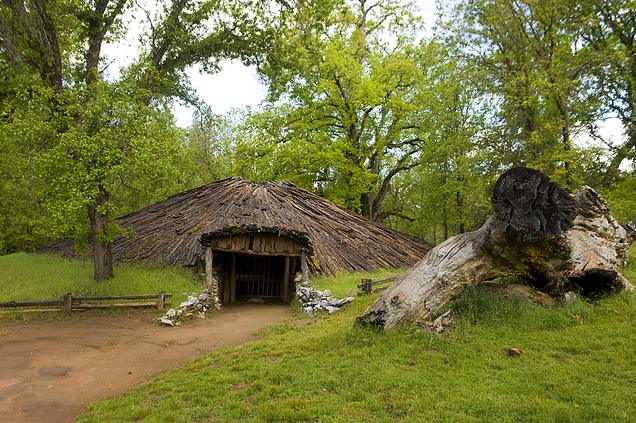
The Roundhouse (hun’ge) is the setting for various social gatherings and ceremonial events.
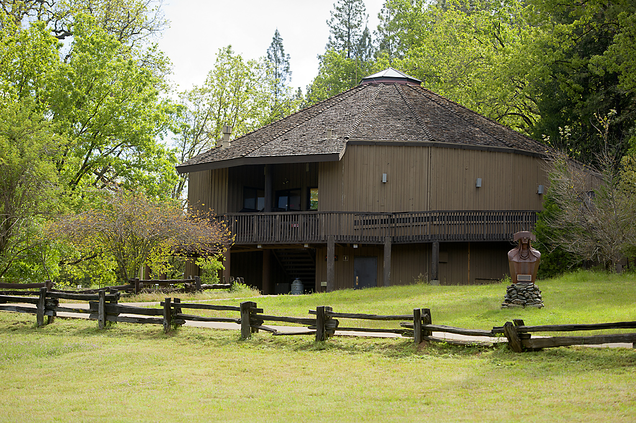
The two-story Chaw’se Regional Indian Museum has been designed to reflect the architecture of the traditional roundhouse. Outstanding examples of the technology and crafts of the Miwok and other Sierra Native American groups are exhibited in the museum.
The collection at Chaw’se includes Northern, Central, and Southern Miwok, Maidu, Konkow, Monache, Nisenan, Tubatulabal, Washo, and Foothill Yokuts.
In a typical village, this semi-subterranean community center was the largest building and tended to be between 20 and 50 feet in diameter. The Indian Grinding Rock State Historic Park hun’ge is 60 feet across — one of the largest in California.
Four massive beams and center poles support the roof. A hole in the center of the roof allows smoke from the fire pit to escape and also permits some observation of the night sky. Miwok homes ranged from eight to fifteen feet in diameter and were built of cedar poles interwoven with grapevines or willow and covered with cedar bark.
A hole was left at the top to vent smoke from cooking or heating fires. Bark houses (u’macha) can be seen near the grinding rock and also at the reconstructed village west of the Roundhouse. A game field (poscoi a we’a) has also been reconstructed near the Roundhouse.
One game played by the Miwok was very similar to soccer. On a field about 110 yards long, players tried to kick or carry a ball to the opposing team’s goal. Both men and women played, though the rules were different for each. Men could only kick the ball, while women could handle the ball in any manner.
However, if a woman held the ball, a man could pick her up and run for the goal.
Fauna
Though the park is small, it offers many opportunities to observe wildlife. Oak woodlands and mixed pine forest also provide more than 130 species of native plants that have been identified in the park, many of which were used by the Miwok.
Spring brings an incredible variety of wildflowers to the Sierra foothills. Flowering plants include monkeyflower, giant trillium, shooting star, several species of lupine, farewell-to-spring, harvest brodiaea, Humboldt lily, western buttercup, mariposa lily, Hartweg’s iris, showy phlox, wild rose, mountain violet, filaree, yellow star flower, and baby blue eyes.
Big Time
Several times each year, ceremonies are held in the hun’ge by local Native Americans. In September, Indian families meet at the park here to pray, to mourn the dead, or to observe special occasions through music and dance.
Recreational Activities
The park is open sunrise to sunset. There is an $8 per vehicle entrance fee.
There are two developed trails in the park.
The North Trail, a one-mile round trip, starts near the museum. It traverses the ridge surrounding the meadow, crosses the creek, passes by the old farm site, and continues to the reconstructed Miwok village site.
There it joins the half-mile South Nature Trail, a self-guided loop that starts near the Roundhouse.
A trail guide describes the ethnobotany of the area, identifying some of the plants that were used by the Miwok.
Examples of basketry, feather regalia, jewelry, arrow points, and other tools are on display. Hours at the museum vary seasonally.
For current hours, visit www.parks.ca.gov or call 209-296-7488.
The nonprofit Chaw’se Association operates a sales area, where visitors may purchase books, posters, postcards, and educational items. Lectures, videos, and demonstrations at the museum provide insights into Native American life in the Sierra region.