By JIM BRUGGER and FRED YERZY
Open Sky Outreach
December heralds the start of winter in the northern hemisphere with the Winter Solstice on the 21st. Although Earth reaches perihelion (closest approach) to the sun about two weeks after the solstice, our chilly weather, long nights, and short days are due to the Earth’s axis tilting away from the sun. We are at a point in our orbit where we face away from the dense galactic core and toward the narrower, outer edge of the Milky Way. As the familiar summer constellations we have enjoyed since spring fade into the west, the winter constellations rise in the east to take their place. Clear, winter nights are great for stargazing with several easily recognizable constellations, bright, jewel-like stars and a smattering of open star clusters and nebulae readily observable to anyone willing to look. December is also a time of joy when we celebrate the holidays with the promise of hope, renewal, and the return of the sun following the winter solstice.
Planet Parade:
Saturn is high in the southeast after sunset and sets in the west around 1 a.m.
Neptune lies a little less than ten degrees (one fist width) to the right (west) of Saturn and can be seen with a telescope.
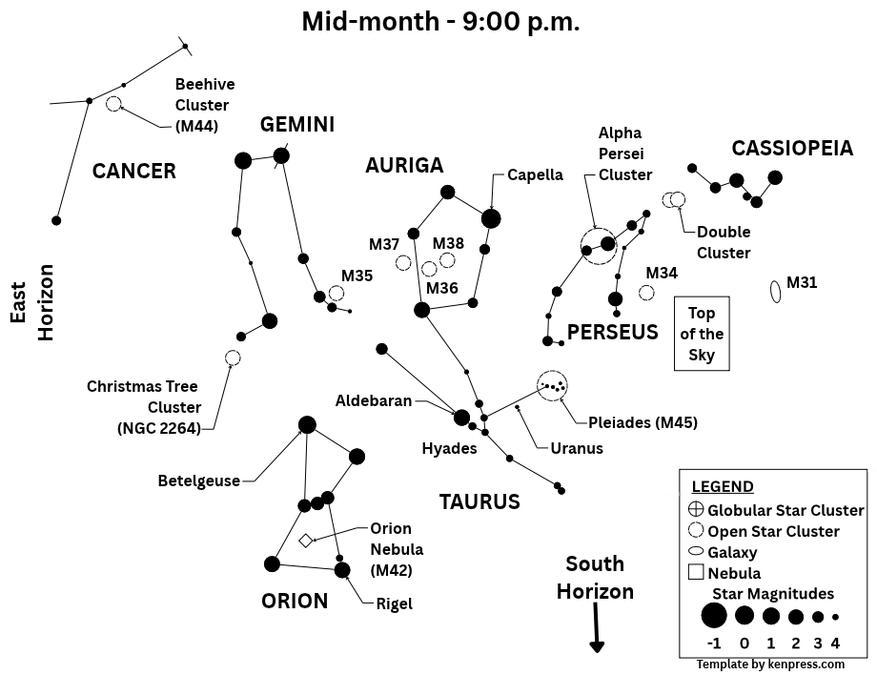
Uranus is in the east after sunset, halfway between the Pleiades Star Cluster and the red giant star Aldebaran in Taurus. You may be able to see it as a small, blue dot in binoculars.
Jupiter rises in the east after 10 p.m. followed closely by Mars. Later in the night, they will be high in the east in Leo.
Venus rises in the east around 4 a.m., becoming a “morning star”.
Mercury is moving back toward the sun, and you may just catch a glimpse of it before sunrise the first week of the month.
Constellations and Celestial Highlights:
The Geminid meteor shower, one of the best shows of the year, is active from December 4-20 and peaks on the night of December 13th/14th. With the waxing, crescent moon setting by 10 p.m., there will be plenty of moonless nighttime available to see up to fifty meteors per hour. Even though the meteors will appear to radiate from Gemini, they can be seen anywhere in the sky.
December is a good month to scan the sky for open star clusters. Two of the easiest to find are the Pleiades and Hyades clusters. Other open clusters that make great targets for binoculars or small telescopes are scattered from Perseus to Auriga and Gemini. Use the bright stars Aldebaran, in Taurus, and Capella, in Auriga, as your guides. Orion also rises in the east after 9 p.m.
Did you know?
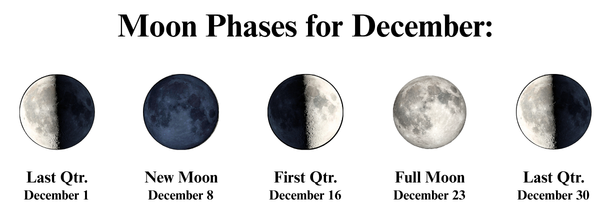
December’s full moon is commonly called the Cold Moon for the time when cold, winter weather and long, dark nights set in. On the 23rd, the full moon will be closer and brighter than average, making it a Full Cold Supermoon.
Winter Solstice in the northern hemisphere is the day when the sun is at its lowest point in the sky, making the shortest day and longest night of the year and has been celebrated across many cultures for millennia. Common traditions include the lighting of candles, connecting with nature, feasting, and setting intentions for the year ahead. Stonehenge, in England, is one of the best-known examples of ancient people’s connection to the cycles of the sun and moon and the solstices. To this day, thousands of people gather at the site on the days of the solstices to watch the sun rise (summer) or set (winter) between the uprights of the Great Trilithon.
NASA has announced that the Voyager 1 probe, launched in 1977, has reached an historical milestone: becoming the first man-made object to travel one light-day from Earth. This means that a signal traveling at the speed of light will take twenty-four hours to reach the spacecraft and another twenty-four hours for us to get a response.
Tech Talk:
Star clusters are groups of gravitationally bound stars that formed together from clouds of gas and dust in Stellar nurseries, like “The Pillars of Creation” in the Eagle Nebula. When conditions are right to form one star, multiple stars often form and create a cluster. Of the three classifications of clusters, two make great targets for amateur astronomers: Globular and Open clusters.
Globular clusters can contain tens of thousands to millions of tightly packed stars. They typically have a dense core and can be up to 450 light years across. Two of the best examples are the Omega Centauri Cluster, the biggest and brightest globular cluster in the galaxy, and the Hercules Cluster, which is readily observable from the Central Valley.
Open clusters are smaller and more loosely bound than globular clusters and may contain from just a handful to a few thousand stars. Open clusters are more plentiful than globular clusters and are found throughout the Milky Way.
Local Outreach Events:
Friday, December 4, 7 p.m. to 10 p.m.: Great Valley Museum Science Night, MJC West Campus, featuring a natural history museum, hands-on exhibits, planetarium shows and rooftop observatory (https://www.mjc.edu/gvm/index.html).
Do you have questions about the local nighttime sky and/or astronomy? Email us at openskyoutreach@gmail.com.