With 17 state capitals being the most populated cities in their states, the personal-finance company WalletHub has released its report on 2026’s Best State Capitals to Live In, as well as expert commentary.
To identify the most livable seats of state government, WalletHub compared all 50 state capitals across 48 key metrics, ranging from the cost of living to K–12 school-system quality to the number of attractions.
Top 10 State Capitals
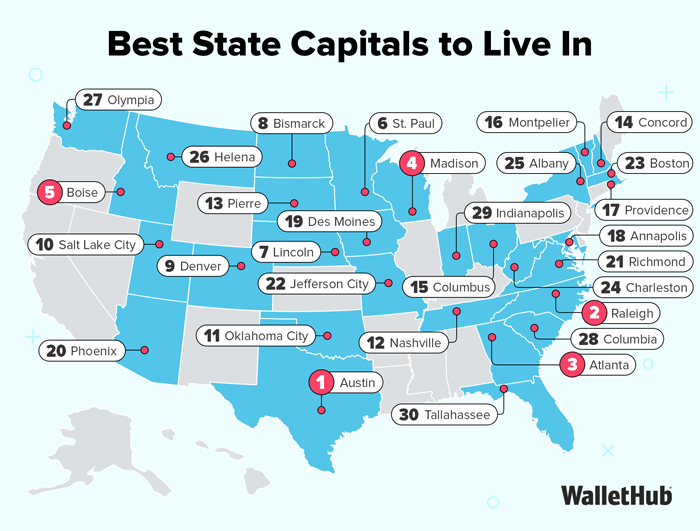
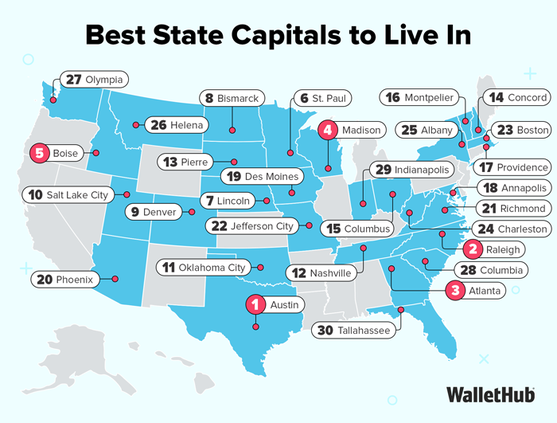
Austin, Texas was rated as the best state capital for living in, followed by Raleigh, NC; Atlanta, GA; Madison, WI; Boise, ID; St. Paul, MN; Lincoln, NE; Bismarck, ND; Denver, CO; and at number 10, Salt Lake City, Utah.
Sacramento, California, came in at number 31 in the survey while the bottom five on the list were Little Rock, Arkansas at number 46; followed by Baton Rouge, LA; Trenton, NJ; August, ME; and, at number 50, Jackson, Mississippi.
Best vs. Worst
Concord, New Hampshire, has the lowest violent-crime rate per 1,000 residents, which is 9.2 times lower than in Little Rock, Arkansas, the city with the highest.
Austin, Texas, has the highest median household income (adjusted for cost of living), which is 2.1 times higher than in Hartford, Connecticut, the city with the lowest.
Montpelier, Vermont, has the highest share of adults age 25 and older with at least a bachelor’s degree, which is four times higher than in Trenton, New Jersey, the city with the lowest.
“A state’s capital city is more than just the seat of its government – it’s also often the center of its economic activity. Some state capitals boast incredible job markets, high average salaries, world-class universities, and an abundance of attractions. Unfortunately, others have populations that are struggling financially, failing public education systems and poor public health systems. States should aim to make their capital city a shining example of the best they have to offer,” noted WalletHub Analyst Chip Lupo. “Texas has the best state capital in the country, in part because Austin has the highest median household income after adjusting for the cost of living, at $93,902. Austin has the second-highest percentage of high schoolers who graduate within four years, along with high-quality university education. Residents of Austin have access to a multitude of attractions, too.”
To view the full report and your city’s rank, visit:
https://wallethub.com/edu/best-state-capitals/19030
Expert Commentary
By Samuel R. Staley, Ph.D.
Director, DeVoe L. Moore Center,
Florida State University
What are the benefits and drawbacks to living in a state’s capital city?
State capitals vary greatly in size, function, quality of life, economic diversity, and demographic diversity. Columbus, Ohio, for example, is a vibrant, growing city covering 11 counties and a regional population of 2.3 million people. Those living in Columbus will have access to all the amenities of a large metropolitan area, including one of the largest and most prestigious and diverse public universities (The Ohio State University), as well as access to numerous smaller ones. Residents can take advantage of professional sports, most notably hockey and professional soccer. The drawbacks, however, include traffic congestion, higher crime rates in the urban area, and higher housing costs. Helena, Montana, on the other hand, is rural and far from an urban setting. The three-county metropolitan area includes just 83,058 people. Those looking for small city amenities in a primarily urban area may find this a very suitable location. Helena will have a slower pace, low crime, and access to vast vistas of Montana’s landscape. Mid-size capital cities, such as Tallahassee, Florida, combine some of these features. A relatively compact city, with a regional population of 330,000 people. Its part-time legislature attracts lobbyists and elected officials supporting a surprisingly wide range of restaurants catering to different ends of the spectrum in taste and expense. As home to two major public universities, Florida State University and Florida A&M, an HBCU, the city has a vibrant, youthful student life (during the academic year) as well as access to high-quality cultural events, including theater.
How have the demographics of capital cities changed in recent years?
As state governments have grown in size and budget, state capitals have attracted higher incomes and more spending. However, the state capitals will vary significantly based on their economic base. Austin, Texas, for example, has a vibrant technology industry and a burgeoning popular cultural nightlife. The city itself has nearly 1 million residents, and its metropolitan area includes 2.55 million. It’s also just an hour and half drive from San Antonio. The effects of larger state governments can be seen in state capitals such as Denver, Tallahassee, and even Cheyenne, Wyoming, where government buildings have come to dominate or at least become significant features of the urban skyline. While this spending and the lobbyists who attend to legislation have built a local economy that caters to higher-end tastes, little evidence suggests that state capitals by themselves spur economic growth. The state capitals that do best economically tend to be the ones tied to large universities or are able to grow diverse economies.
What are the main challenges faced by capital cities nowadays?
I believe the biggest challenge facing capital cities lies in their ability to diversify their economies to provide more economic opportunities for local residents. Just like other cities, relying too much on one industry tends to limit economic growth. Government functions tend to support services that focus on the needs of elected officials, lobbyists, trade associations, etc., which can be seen (economically) as wealthy tourists. Long-term, economies need to build economies that provide goods and services to a wider base, especially those that can be ‘exported’ outside the region.
How does exempting government buildings from local property taxes affect the fiscal well-being of capital cities?
Exempting government buildings from local property taxes is a substantial fiscal burden for capital cities. This is one reason why capital cities should focus on diversifying their economic base beyond state (and local) government functions and nonprofit organizations. Fortunately, many state governments provide revenue offsets through intergovernmental grants and transfers to help support core public services.