With the tax filing deadline approaching and some states receiving significantly more in federal aid than they pay in taxes the personal finance company WalletHub has released its updated rankings of the 2026’s Most and Least Federally Dependent States, along with expert insights.
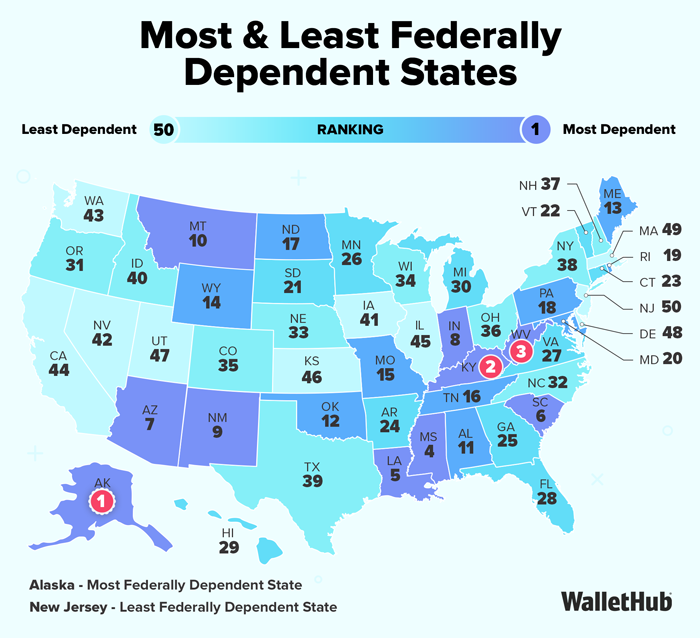
The report highlights the degree of economic independence among states. To determine which states rely most and least on federal support, WalletHub evaluated all 50 states using three key measures: the return on federal taxes paid, federal funding as a percentage of state revenue, and the share of federal jobs.
Top five most federally dependent states were Alaksa at number one, followed by Kentucky, West Virginia, Mississippi and Louisiana. The five least federally dependent states were Kansas, at number 46, followed by Utah, Delaware, Massachusetts and New Jersey. California ranked 44th overall.
Federal Dependency of California (1=Most Dependent, 25=Avg.):
46th – Return on Taxes Paid to the Federal Government
38th – Federal Funding as a Share of State Revenue
39th – Share of Federal Jobs
“Regardless of whether the distribution of federal funds is fair or not, living in one of the most federally dependent states can be beneficial for residents. For every dollar residents of the top states pay in taxes, they get several dollars back in federal funding, which often leads to higher-quality infrastructure, education, public health and more,” explained WalletHub Analyst Chip Lupo. “Alaska is the most federally dependent state, with nearly 45 percent of the state’s revenue coming from federal funding. For every $1 that residents pay in taxes, the state receives $2.52 in federal funding. Plus, nearly five percent of Alaska’s workforce is employed by the federal government, one of the highest rates in the country.”
For the full report, visit:
https://wallethub.com/edu/states-most-least-dependent-on-the-federal-government/2700
Expert Commentary
By Andrew Burnstine, Ph.D.
Associate Professor, Lynn University
Should federal resources be allocated to states according to how much they pay in federal taxes, or should some states subsidize others?
Think of the United States like a massive family where some siblings earn more than others. If we only gave back exactly what each state paid in, the wealthier states would see a massive windfall while others might face immediate insolvency. This isn’t just about charity; it is about national stability. If a bridge fails in a rural state or a natural disaster hits a coastal region, it ripples through the entire national economy. Currently, the system acts as a giant insurance policy. States like New Jersey and Massachusetts are typically net contributors, while states like New Mexico and West Virginia often receive more than two dollars in benefits for every dollar their citizens pay in federal taxes. Subsidizing ensures that a child in a low-income area still has access to the same basic infrastructure and safety as a child in a wealthy tech hub.
Which programs should be a state or local responsibility and which should be a federal responsibility?
A good rule of thumb is that if a program is personal and local, the states should handle it. If it needs to be uniform for everyone, the feds should take the lead. Things like K-12 education, local law enforcement, and regional transit are best managed by people who actually live in those zip codes. You don’t want a bureaucrat in DC deciding the school curriculum or bus routes for a town in the Midwest. However, when it comes to activities that cross borders, such as national defense, interstate highways, or Social Security, the federal government has the scale to do them right. Friction usually occurs in the middle, with programs like Medicaid, where the federal government provides the cash but states often want more say in how to spend it.
What is the fairest way to redistribute federal resources back to the states?
Fairness is often found in a hybrid approach that combines population-based funding with needs-based formulas. If you distribute money strictly by population, you ignore the fact that it costs far more to provide services in a massive, sparsely populated state than in a dense city. The most logical path is to use flexible block grants. These give states a bucket of money with fewer strings attached, allowing them to solve their specific problems. A key metric to consider is Taxpayer ROI. States like Florida and New Hampshire are frequently cited for providing quality services and maintaining high rankings for taxpayer value without an individual state income tax.
What more can the current administration do to help reduce the impact of revenue shortfalls in state budgets during the current economic climate?
With ten states already facing deficits and others showing flat revenue growth in 2026, the administration needs to prioritize stability over surprises. Stop moving the goalposts on matching funds for healthcare; when federal rules change mid-year, it leaves governors with massive holes they didn’t plan for. Streamlining the permit process for new energy and tech projects would also help, injecting immediate jobs and tax revenue into local economies to offset the post-pandemic ‘free money’ era as it dries up. The most compelling talking point for 2026 is the birth of the Fiscal Fortress State. Instead of waiting for a federal rescue, states are aggressively building their own lifeboats. In fact, 29 states have now grown their rainy-day funds to a median of over 14 percent of total spending, the second-highest level in history. This shift signals that the era of state dependence on Washington is fading as a new age of state-level self-reliance begins.