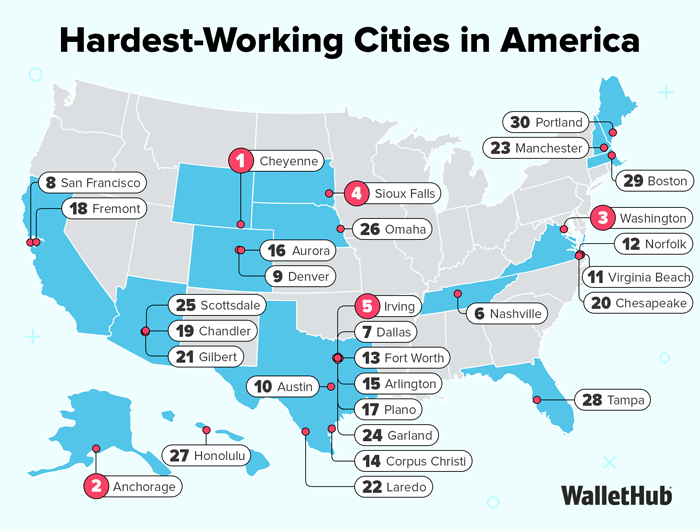
With March 6 observed as Employee Appreciation Day and Americans working an average of 1,796 hours per year—far more than workers in many other industrialized countries—the personal-finance company WalletHub has released its report on 2026’s Hardest-Working Cities in America, along with expert commentary.
To identify where Americans work the hardest, WalletHub analyzed the 116 largest cities across 11 key metrics. The data set ranges from employment rate, average weekly hours worked, and the share of workers with multiple jobs.
Top 20 Hardest-Working Cities in America
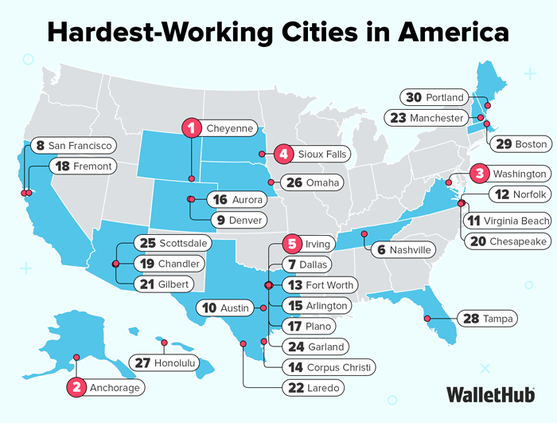
Cheyenne, Wyoming was at the top of the survey, coming in at number one. It was followed by Anchorage, AK; Washington, DC; Sioux Falls, SD; Irving, TX; Nashville, TN; Dallas, TX; San Francisco, CA; Denver CO; and, at number 10, Austin, Texas.
Rated number 11 through 20 were Virginia Beach, Virginia; Norfolk, VA; Fort Worth, TX; Corpus Christi, TX; Arlington, TX; Aurora, CO; Plano, TX; Fremont, CA; Chandler, AZ and rounding out the top 20, Chesapeake, Virginia.
Key Stats
Irving, Texas, has the lowest share of households where no adults work, which is 3.6 times lower than in Detroit, the city with the highest.
New York City has the longest average commute time, which is 2.6 times longer than in Fargo, North Dakota, the city with the shortest.
Baltimore contributes the most annual volunteer hours per resident, which is six times more than in Jacksonville, Florida, the city that contributes the fewest.
Boston, Massachusetts, Minneapolis and St. Paul city, Minnesota, have the lowest share of idle youth 16-24-years-old, which is 2.6 times lower than in Bakersfield, California, the city with the highest.
“Hard work is the backbone of America’s economy and a big reason why the country has become so successful, as Americans outwork people in many other developed economies. In addition, between 40 percent and 64 percent of Americans leave at least some of their allotted vacation time on the table, depending on the city,” said WalletHub Analyst Chip Lupo. “While working long hours, minimizing time off, and having side jobs all lead to increased productivity, they can also have negative effects on people’s physical and mental health. It’s important for people to figure out how to work hard without overworking.”
To view the full report, visit https://wallethub.com/edu/hardest-working-cities-in-america/10424
“Cheyenne, Wyoming, is the hardest-working city in the U.S., in part because it ranks highest for average workweek length, with employees averaging 40.7 hours per week,” Lupo added. “Cheyenne also has the fifth-highest share of workers holding multiple jobs. Additionally, it ranks in the top half of cities for employment rates, meaning a large share of the population is actively engaged in the labor force.”
Expert Commentary
Research shows that Americans work 25 percent more hours than their counterparts in Europe. Why do Americans work so much more, and is it worth it?
“Americans work longer hours largely because the U.S. shifts more economic risk onto individuals. With limited mandated paid time off, weaker labor protections, and fewer universal support for healthcare, childcare, and retirement, working longer hours functions as a form of self-insurance. Those pressures intensified after the 1970s. While European countries increasingly converted productivity gains into shorter workweeks and guaranteed leave, the U.S. converted them into longer hours and higher individual exposure to risk. Over time, working more became the default way to stay afloat rather than a path to getting ahead. Is it worth it? For most workers, no - at least not in a sustained way. Longer hours can raise short-term income, but they reliably come with tradeoffs: poorer health, higher stress, and diminishing returns to performance. Beyond a point, extra hours fail to produce meaningful gains in financial security or well-being.”
Matthew J. Grawitch, Ph.D. – Director, Strategic Research, School for Professional Studies, Saint Louis University
“Factors such as cultural norms, economic structures, and social safety nets significantly affect work culture in the U.S. The ‘American Dream’ places a strong emphasis on individual achievement, career advancement, and income growth, although it has become increasingly difficult to achieve in high-cost states such as California. In contrast, many European countries cap weekly working hours below 40 or actively promote reduced work schedules, such as shorter workweeks or four-day work arrangements. Moreover, they provide stronger protections in paid leave, vacation time, job security, public healthcare, and retirement benefits than the U.S. As a result, Americans often work longer hours to save for emergency funds and retirement. Is working longer hours ‘worth it’? It can be, especially when people enjoy and find meaning in their work. It is not when they feel disengaged or dissatisfied with their jobs. Working longer hours also increases the risks of burnout and stress and negatively affects overall well-being. Over time, the marginal benefits of working more hours tend to diminish, particularly when physical and mental health are compromised.”
Linchi Kwok, Ph.D. – Professor, Cal Poly Pomona
Does working more hours always translate into higher productivity? Does this vary by industry or job type?
“No, working more hours does not directly translate into higher productivity. What matters foremost is how effectively time is used, not how much time is logged. Someone can spend all day at work and accomplish very little, while another person can produce high-quality output in far fewer hours. Even when hours are spent productively, though, research consistently shows that beyond a point in the workday, additional hours yield diminishing returns, with more errors, more rework, and impaired judgment. Longer hours can create the appearance of greater effort while subtly - or even not so subtly - reducing real output. But, yes, this varies by industry and job type. The effects are strongest in cognitive and decision-intensive roles, such as management, professional services, healthcare, and knowledge work, where fatigue degrades reasoning, attention, and error detection. In more routine or manual jobs, longer hours may boost output temporarily, but injury risk, mistakes, and long-term performance costs rise as fatigue builds. Prolonged overwork also interferes with recovery. When workers don’t have sufficient time to rest and psychologically disengage, they tend to become more easily fatigued and work becomes more stressful. This can increase the likelihood of burnout and disengagement, decrements in well-being, and adverse effects on productivity.”
Matthew J. Grawitch, Ph.D. – Director, Strategic Research, School for Professional Studies, Saint Louis University
“Working more hours does not necessarily translate into higher productivity. In many cases, productivity plateaus or even declines after a certain point due to fatigue, reduced focus, and lower job satisfaction. This relationship varies significantly by industry and job type. For example, knowledge-based and creative roles often rely on cognitive performance, problem-solving, and innovation, which tend to suffer when employees are overworked. In contrast, some operational or time-based roles may show a more direct relationship between hours worked and output, at least in the short term. Research in learning and cognitive science suggests that taking regular breaks or switching between different types of tasks can help maintain cognitive performance and productivity. This is why labor laws in many countries mandate rest breaks during the workday to reduce fatigue and support sustained performance rather than continuous overwork. Overall, productivity is more closely tied to work design, employee engagement, and recovery time than to total hours worked.”
Linchi Kwok, Ph.D. – Professor, Cal Poly Pomona
How has employee engagement changed in recent years?
“Employee engagement hasn’t collapsed in the dramatic way it’s often portrayed. Much of the ‘engagement crisis’ narrative is driven by how engagement is defined and labeled, particularly by proprietary surveys that turn a normal distribution of attitudes into alarming headlines. By those metrics, engagement looks chronically low every year by design, regardless of economic conditions. That said, it would be a mistake to conclude that nothing has changed. What has shifted in recent years is the context surrounding work. Many employees are being asked to do more with fewer resources, while real wages have failed to keep pace with inflation. That combination creates sustained pressure, longer hours, and fewer opportunities for recovery.”
Matthew J. Grawitch, Ph.D. – Director, Strategic Research, School for Professional Studies, Saint Louis University
“The COVID-19 pandemic fundamentally reshaped how people view work, prompting many employees to reassess their priorities, expectations, and definitions of success. In the U.S., employee engagement reached one of its lowest levels in recent years, according to Gallup surveys conducted in 2024. Several new terms also emerged to describe employee disengagement and negative workplace sentiment, such as Quiet Quitting, Quiet Cracking, and the Great Resignation. Although recent labor reports and employer actions, such as ending work-from-home arrangements and requiring employees to return to the office, suggest that the Great Resignation has largely subsided, it will likely take time for organizations to fully re-engage their workforce.”
Linchi Kwok, Ph.D. – Professor, Cal Poly Pomona